
I first heard about the new Mirari computer for MorphOS and AmigaOS in April 2025 on amiga-news.de. Since then, we have been following its development (https://mirari.vitasys.nl/the-first-rebirth/) and eagerly awaiting its arrival on the scene.
Mirari is the work of Skateman (Dave Koelman) and Geennaam (Harald Kanning) and was created with the aim of bringing an entry-level PowerPC motherboard for MorphOS and AmigaOS, fast enough and with new technologies such as NVME and USB 3.
The computer is designed for NXP T1042 and T2081 processors. Work is now intensively underway on the T1042 version.
I was lucky enough to get my hands on one. It immediately ended up on the testbed so I could find out what we can look forward to.
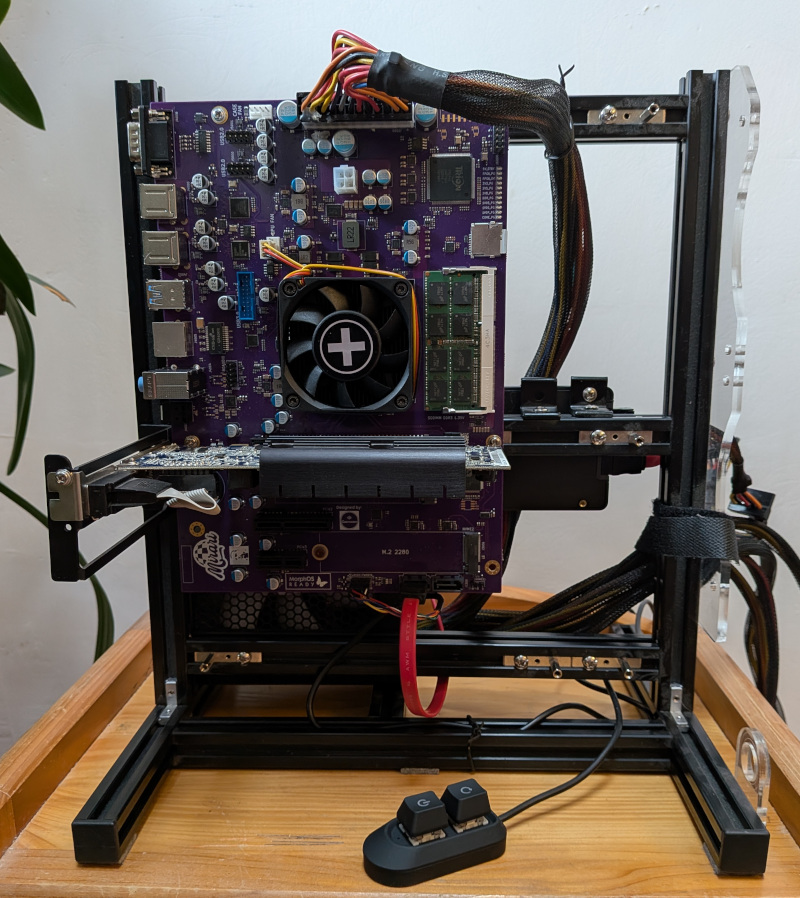
The basic parameters of Mirari are as follows:
- CPU: T1042 (4x e5500 core), 1.4 to 1.6 GHz, 256 KB L2 cache, 256 KB platform cache (L3), Power ISA v.2.06
- RAM: up to 32 GB DDR3L, 800 MHz, supports interleaving
- HDD controller: 2x SATA v2.6 )*
- NVME interface: 2x )*
- Ethernet: 1 GbE
- USB2.0: 4x external + 4x internal
- USB3.2 Gen1: 2x external + 2x internal
- Expansion slots:
- 1x PCIe v 2.0, x4 lanes (x16 connector)
- 1x PCIe v 2.0 / 3.0 )*, x1 lane, ( x4 connector )
- 1x PCIe v 2.0, x1 lane
)* 2x SATA + 1x NVME, or 1x SATA + 2x NVME
)** with T2081 processor is PCIe v3.0
First impressions
I won't pretend – my first impressions are great. UBoot allows you to set the processor frequency from 1.4 GHz to 1.6 GHz, select the third NVME or SATA2 storage, and set boot parameters for AmigaOS, MorphOS and Linux. In the future, UBoot will also allow you to set detailed RAM parameters for fine-tuning or fan speed control profiles with regard to noise and performance.
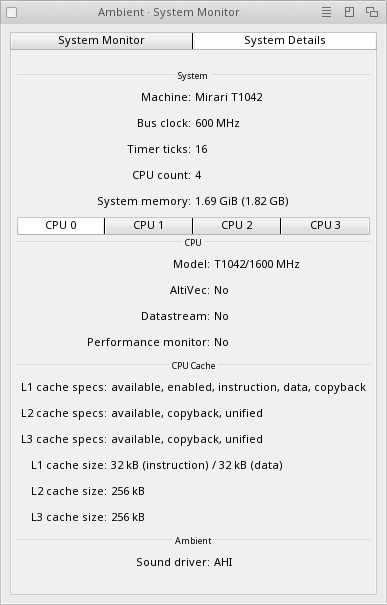
MorphOS 3.20 – although not yet the final version – is very stable here. Both NVME and SATA2 drivers work, and both devices can be booted from. All peripherals and 3D graphics work without any problems. As of today, USB 3.0 drivers are not yet available.
Processor performance
I have tried many MorphOS computers and was very curious about the speed of Mirari. I have the processor frequency set to 1.6 GHz (except for testing). Actually, I have no reason to keep the lower setting. Even during stress tests, I was unable to get the CPU temperature above 45 °C.
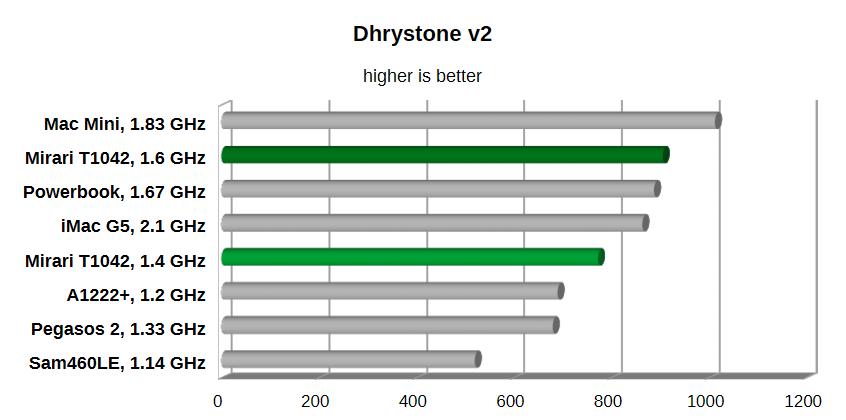
What real speed can we actually expect? The processor has an e5500 core, the same as the AmigaOne X5000. Compared to it, the speed will be proportional to the frequency - i.e. 80% of the X5000's performance. Compared to G4 and G5 processors, it will probably be faster than the frequency ratio would suggest.
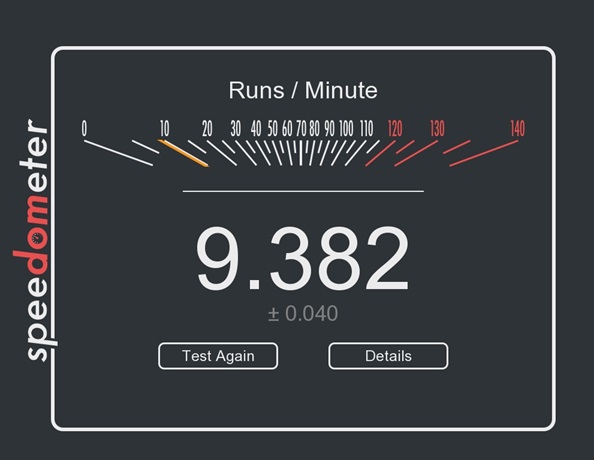
For example, the web browsing speed of the Mirari 1.6 GHz is 15% higher than that of the overclocked Mini 1.8 GHz:
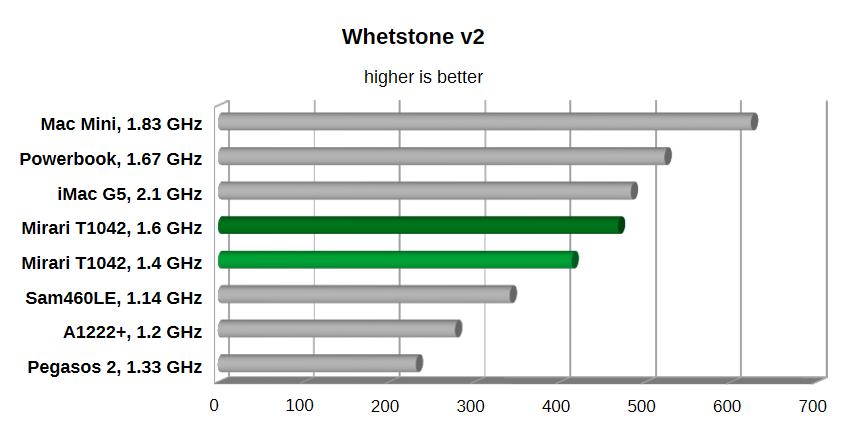
So let's take a very brief look at the results of real-world tests. In addition to G4 and G5 computers, I will also use an A1222+ (with AmigaOS) and a Sam460LE for comparison.
We will test the raw CPU performance using the Dhrystone v2 benchmark:
Next, we will look at the performance of floating-point operations with the Whetstone v2 benchmark:
Memory and cache
This is what the block diagram of the T1042 processor looks like.
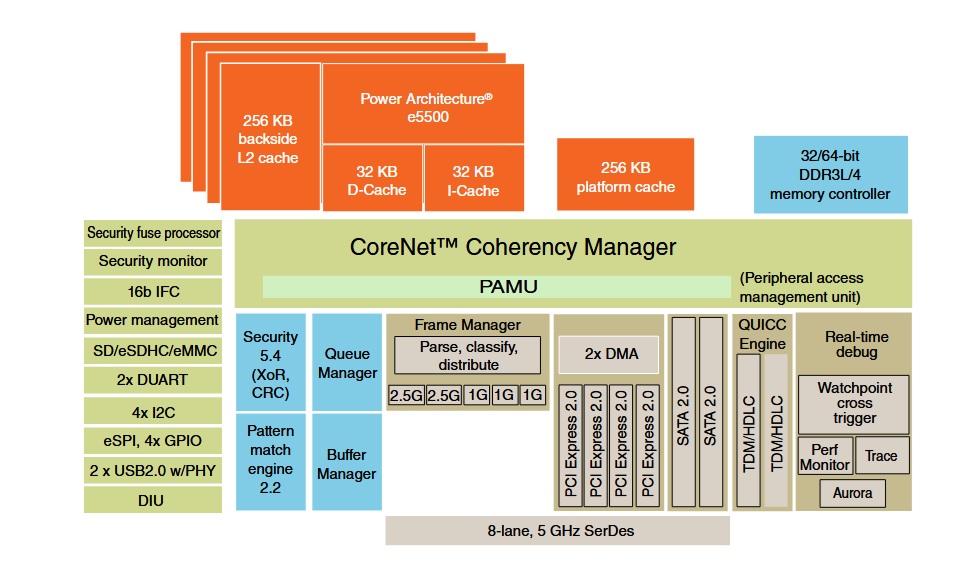
Each core has 32 KB of cache for instructions and data and 256 KB of unified L2 cache. A 256 KB L3 cache is located between CoreNet and the DDR3 controller. The CoreNet platform ensures communication and data coherence between the CPU, memory and peripherals.
How fast is this memory? The Mirari T1042 can have one SO-DIMM DDR3L module with a frequency of 800 MHz (1600 MT/s, PC3-12800). The controller supports rank interleaving.
To measure cache and RAM speeds, I used the ramspeed programme ( I recompile it and place to morphos-storage and os4depot so you can compare with your AmigaNG).
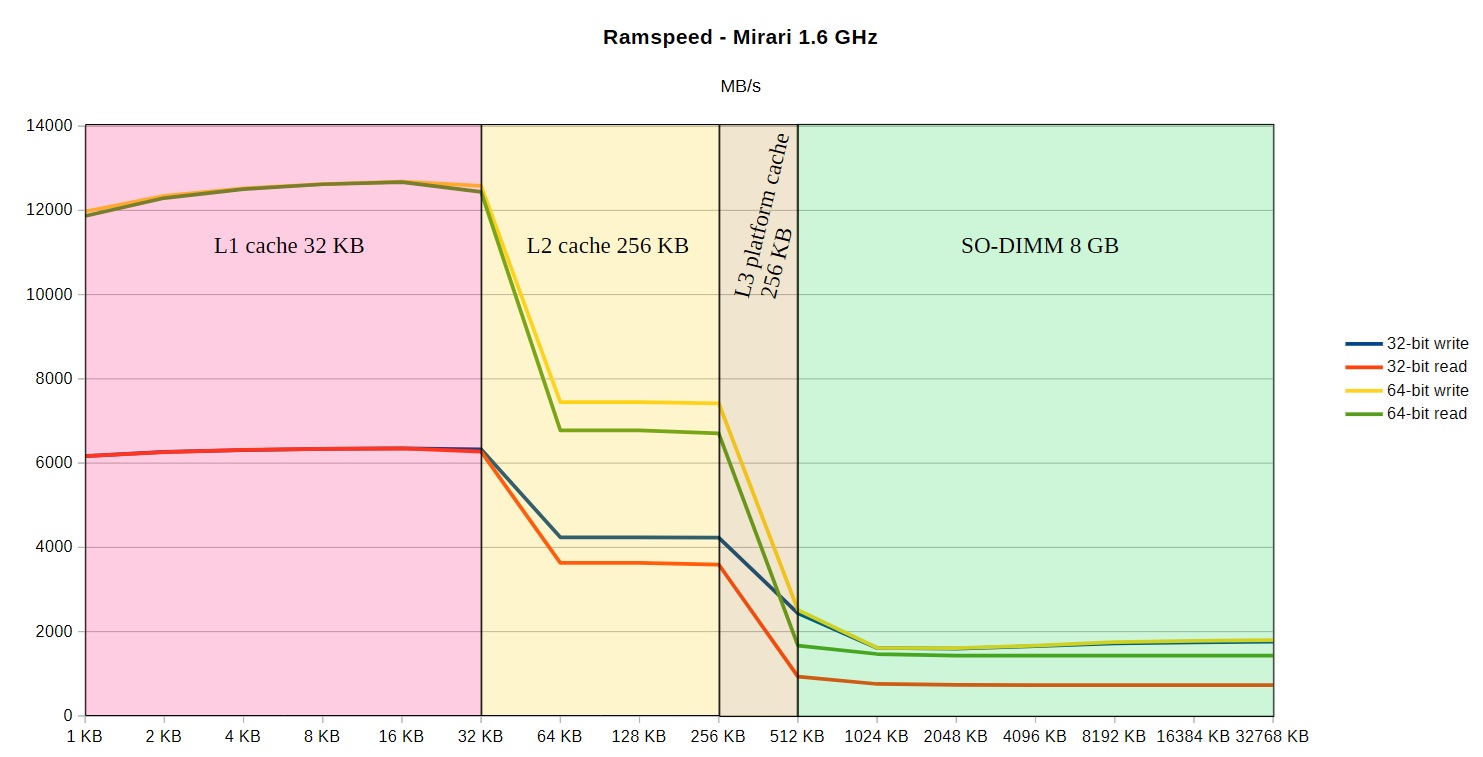
L1 achieves the highest speed of 12,680 MB/s, L2: 7,446 MB/s, L3: 2,515 MB/s and RAM 1,796 MB/s.
To avoid going into too much detail, we will compare with others using the arithmetic mean of the read and write speeds of 32- and 64-bit data.
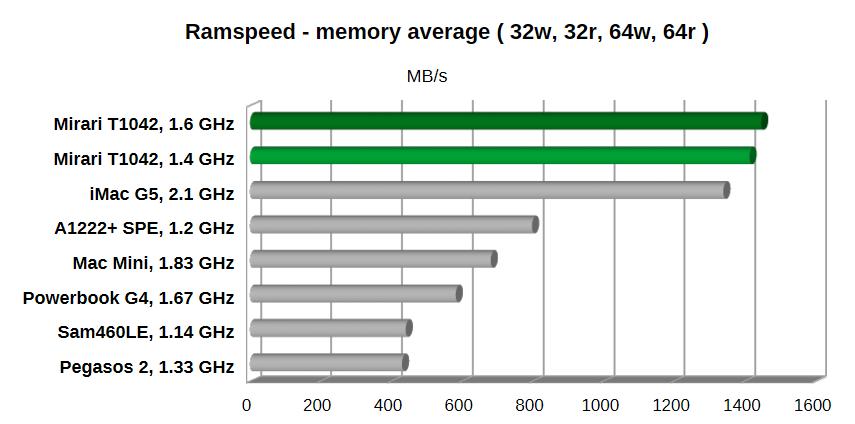
A frequently used benchmark for measuring memory speed is Stream, which measures the flow rate of 64-bit floating-point data with Copy, Scale, Add, and Triad operations. The graph shows the arithmetic mean of these operations.
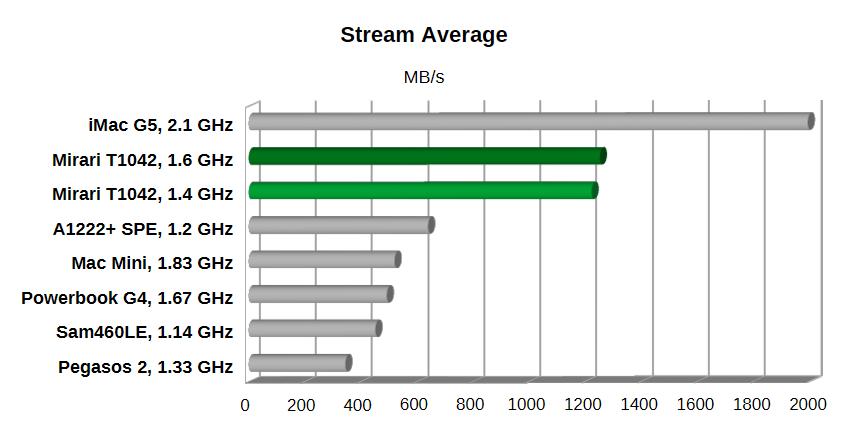
Here, the G5 is the fastest processor because, unlike the others, it contains a hardware prefetcher. The programme can be modified in software (again by Harald) so that the G4 and T1042 have similar functionality, and then the Mirari 1.6 GHz achieves a speed of 1700 MB/s. However, I do not show this in the graph because Stream in its original form is an industry standard and common applications do not usually have this optimisation.
Even so, Mirari's performance is excellent. And note the A1222+ speed - not bad for for 1.2 GHz computer.
NVME and SATA
Another thing I was very curious about was storage speeds. Harald is the author of NVME drivers for MorphOS and AmigaOS. Even when I was testing the beta version, the NVME speed on the X1000 was amazing.
The T1042 processor contains two SATA v2.6 controllers. NVME are always connected to one PCIe 2.0 line.
I measured the speeds of both the buses and the disk subsystems, but for simplicity's sake, I will only give one summary result here - the speed of copying a large file to RAM:.
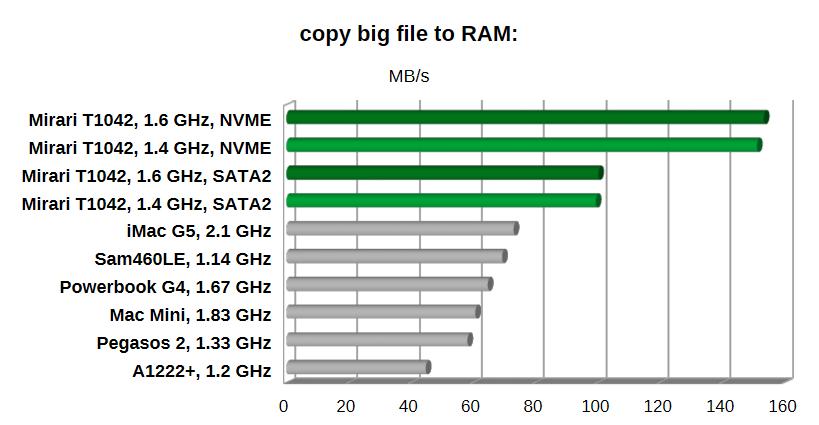
Here it is completely clear that Mirari is the absolute king in this discipline. And the new NVME technology only emphasises this.
FPS games
And how does gaming look on Mirari?
I have added the fastest machine to date to the list - the Powermac G5 Quad. Measuring games is always more complicated, as it also depends on the graphics card and speed of the gfx chip driver. Here, the X1900 is used for the Powermac Quad, the X1950 XT for Mirari, and the Radeon 9800 Pro for Pegasos 2.
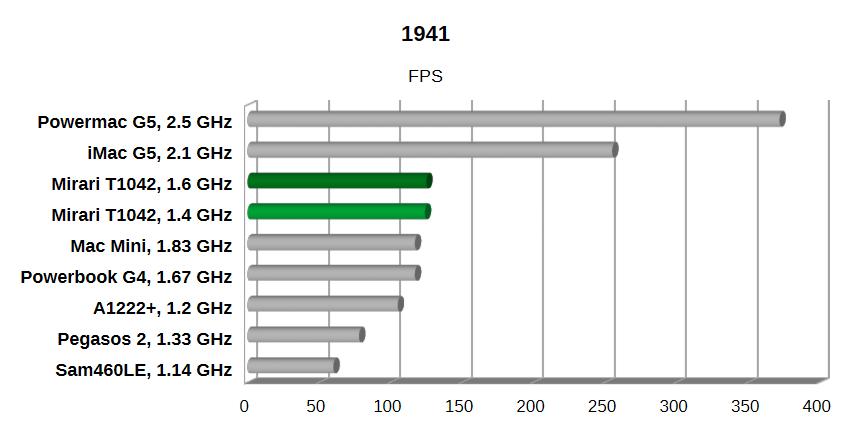
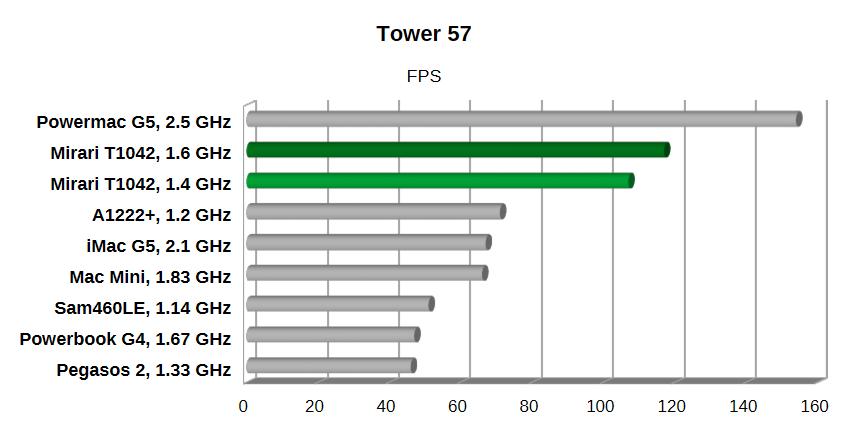
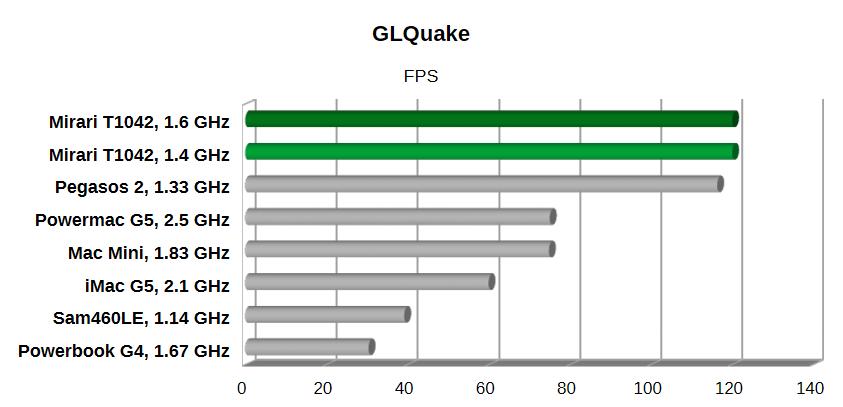
So I can say that when it comes to gaming, the technology used matters a lot. However, I can say that Mirari is perfect for gamers. It's simply a great computer in every way.
So what can we look forward to?
Mirari with MorphOS 3.20. I think the release is not too far away. And I hope that AmigaOS4 release will follow.
Mirari:
- is new - that's a big advantage when most of our AmigaNG machines are twenty years old
- it is powerful – it has four e5500 cores up to 1.6 GHz
- it is expandable – after installing disks, NVME and a graphics card, you still have two expansion slots left
- it is designed for AmigaOS, MorphOS and Linux
I think this brief introduction shows that if Mirari succeeds, it will be an ideal replacement for virtually all existing computers for AmigaOS and MorphOS.
In terms of performance, it is surpassed only by the Powermac G5 and AmigaOne X5000 ( and maybe X1000 ). However, if a version with a T2081 processor (4x e6500 core with AltiVec, 1.8 GHz) is released in the future, it may even shake the position of the current king and queen.